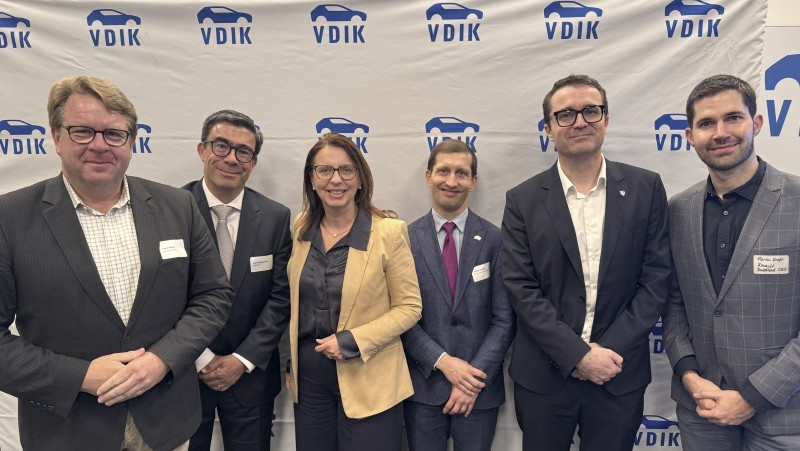


The potential and challenges that autonomous driving presents for the automotive industry were the focus of the joint expert dialogue “Future of Mobility,” organized by the Association of International Motor Vehicle Manufacturers (VDIK) and Automechanika Frankfurt at the VDIK’s Berlin office.
VDIK President Imelda Labbé emphasized: “Autonomous vehicles offer significant advantages in terms of safety and comfort. That is why autonomous driving will be an integral part of individual mobility in the future. Now it is crucial for the automotive industry and tech companies to collaborate more closely to bring this technology into practical use in Germany and Europe.”
In his keynote address, Prof. Dr. Andreas Herrmann of the University of St. Gallen emphasized that driverless mobility could transport more people—while using less space, producing fewer emissions, and resulting in significantly fewer accidents. Practical examples are already emerging from the U.S.: According to its own figures, Waymo has covered more than 320 million kilometers autonomously there and handles around 500,000 trips per week. In China, too, autonomous mobility is increasingly becoming part of everyday life, while in many parts of Europe it is still in the testing phase.
Closely linked to this development is the question of future value chains. Herrmann expects that large technology companies will occupy key control points. In addition to vehicle and software technology, these include fleet operations, mobility platforms, services, and the customer experience. The profit pool will continue to shift from hardware to software. For the automotive industry, this raises the question of which parts of the value chain it will be able to occupy and secure in the future.
Anita Geißler, an advisor on autonomous driving at the Federal Ministry of Transport, also emphasized that the transition from the testing phase to regular operation must be successful. New technologies initially generate uncertainty and fears. However, trust is built through visible and safe applications—with fewer accidents, greater comfort, and higher traffic efficiency. Policymakers and industry should therefore take more risks and continue to develop innovations within an agile legal framework.
Max van Kleek, Associate Professor of Human-Computer Interaction at Oxford University, expressed the view that the future of artificial intelligence and autonomous driving has already begun—even if it is not yet equally visible everywhere. He presented new AI applications with societal benefits and refuted fears of widespread job losses. The key, he said, is to capitalize on the technological opportunities and create new possibilities for the world of work and society.
Dr. Matthias Kempf, Managing Partner at Leap4 Venture Capital, addressed some critical issues. About 40 percent of deep-tech founders come from Europe. However, as companies grow in size and market capitalization, many migrate to other regions, particularly the U.S. Europe has strong ideas and talent, but there is often a lack of collaboration between policymakers and businesses to generate the investment needed to keep the technology in Germany.
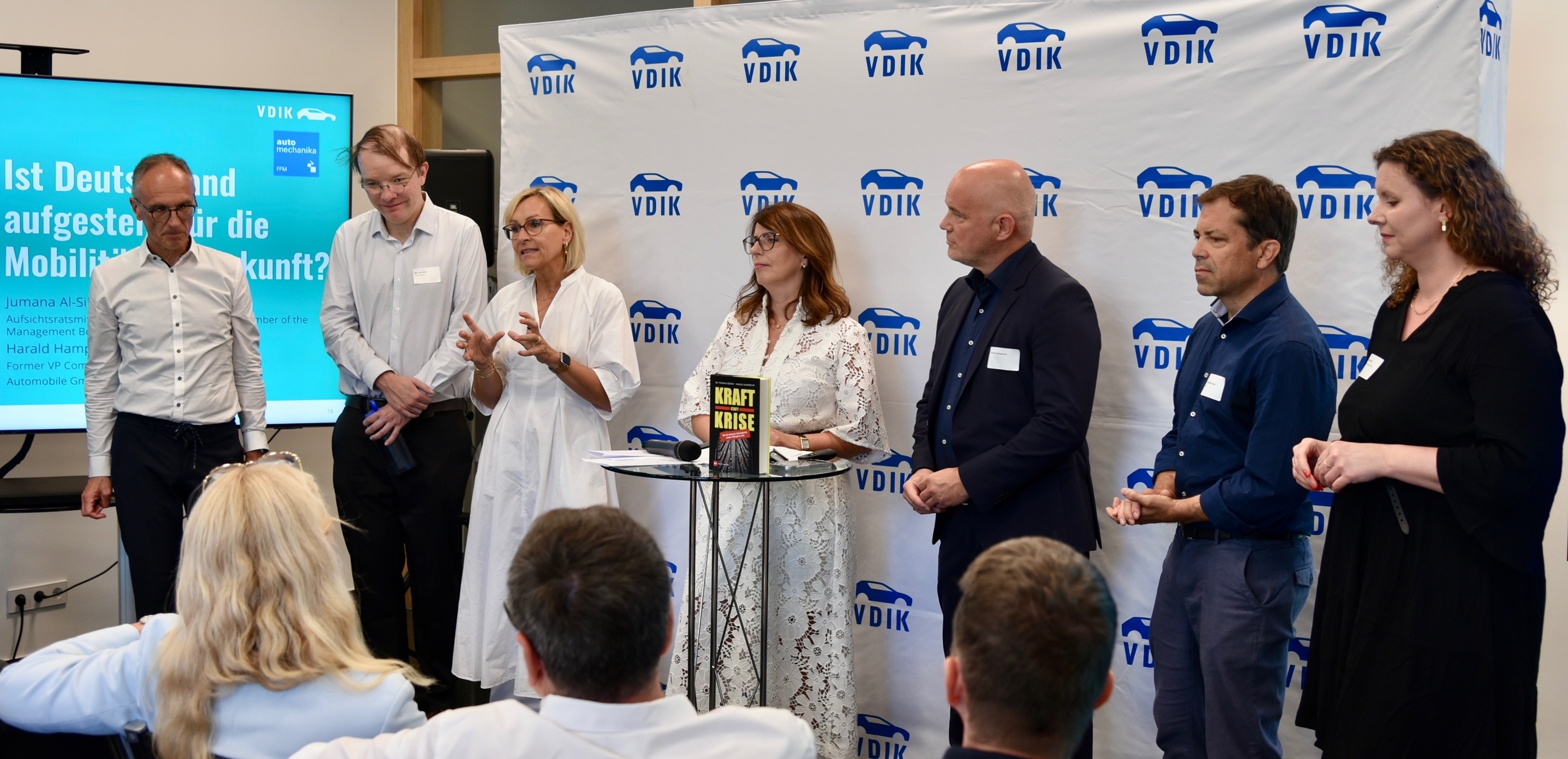
In the concluding panel discussion, Jumana Al Sibai, a former member of Mahle’s Executive Board, and Harald Hamprecht, co-author of the book “Kraft statt Krise” and former head of public relations at Opel, joined the speakers in a discussion. Implementing innovation and transformation in the software sector with AI requires leadership and a radical willingness to change within companies; this places enormous demands on executives.
Automechanika Frankfurt offers another platform for discussion about the future of the automotive industry. Olaf Mußhoff, the trade show’s brand manager, highlighted the growing importance of the after-sales business in connection with vehicle fleets. Fleet vehicles cover significantly higher annual mileage and consequently require more maintenance and replacement parts. The world’s leading trade show for the automotive aftermarket will take place from September 8 to 12 in Frankfurt am Main. On September 8, the Automotive Aftersales Award, presented by Auto Bild, Automechanika, and VDIK, will also be handed out there.