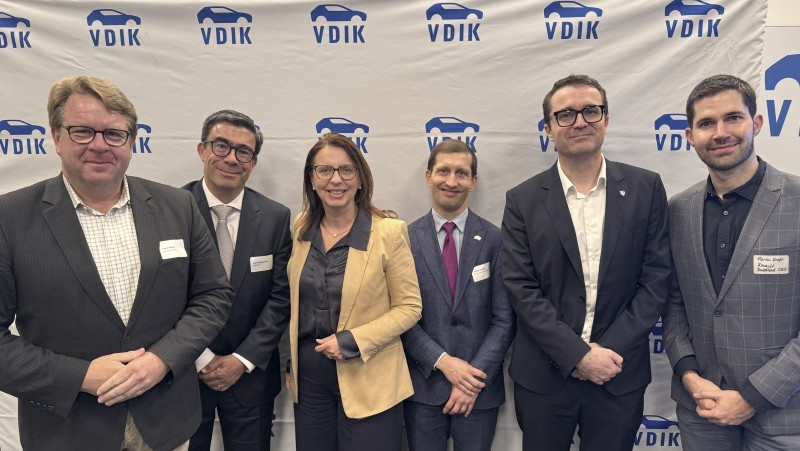


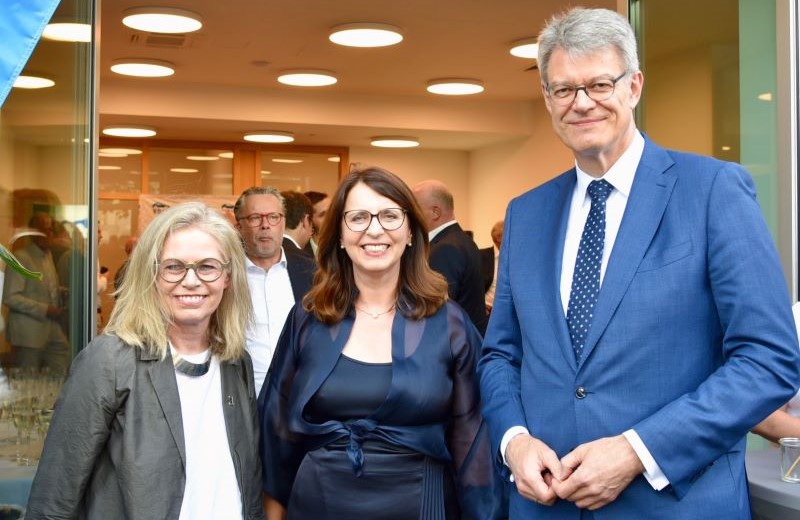
At the Berlin event hosted by the Association of International Motor Vehicle Manufacturers (VDIK), VDIK President Imelda Labbé welcomed Berlin’s Senator for Transportation, Ute Bonde, and Federal Minister of Transportation Patrick Schnieder.
“The transformation can only succeed if the federal government, the states, and local authorities work together to create the right framework conditions. This applies to the ramp-up of electric mobility for passenger cars and trucks, as well as to autonomous driving in the future. That is why we need a master plan for the transformation that includes all stakeholders—including the energy sector,” said Labbé.
At the same time, she warned against excessive European regulatory initiatives. Too many material specifications lead to additional bureaucracy and place a burden on manufacturers and authorities alike. Some requirements are currently difficult or impossible to meet with European production, or can only be met at costs that jeopardize affordable mobility. The VDIK therefore calls for greater engagement by the federal government in Brussels and a stronger focus on promoting innovation, and welcomed the governing coalition’s unified position as an important prerequisite for effectiveness.
Labbé gave a positive assessment of the progress made in digital vehicle registration and vehicle documentation, as well as the first steps toward reducing bureaucracy. He also noted that the federal government’s recent signals regarding the strengthening of Germany as a business location were an important sign ahead of the summer recess, even though further action is still needed.
In his keynote address, Federal Minister of Transportation Patrick Schnieder called for a faster expansion of the charging infrastructure in Europe. He emphasized that Germany should not be viewed in isolation in this context. He referred to subsidy programs for public charging stations, vehicle depots, and multi-unit residential buildings, for which the federal government is providing a total of 500 million euros. Regarding autonomous driving, he noted that the transition from the pilot phase to widespread adoption must now succeed.
Schnieder also took a clear stand against the European Commission’s proposed regulation on the decarbonization of corporate fleets. He rejected mandatory fleet quotas for clean vehicles.
Ute Bonde, Berlin’s Senator for Mobility, Transportation, Climate Protection, and the Environment, highlighted Berlin’s progress in expanding its charging infrastructure. She noted that the focus now must be on creating more attractive services for electric mobility in addition to the infrastructure. She sees autonomous driving as a key component for Berlin’s position as a center of business and industry.
VDIK General Assembly Elects Board of Directors
At the VDIK General Assembly, Imelda Labbé (President), Bernhard Kaplan (Mazda), Vincent Ricoux (Stellantis), and Jan-Kas van der Stelt (Jaguar Land Rover) were elected to the Board of Directors for another two years. Frank Barwasser (Škoda) and Jens Schulz (Mitsubishi)—who also serves as the association’s vice president—were elected to serve one-year terms.