

In February, the market for alternative powertrains (all-electric, plug-in and non-plug-in hybrids, and natural gas vehicles) grew by 15.0 percent to 131,513 units, with international brands accounting for approximately 42.9 percent. This is evident from an analysis of figures from the Federal Motor Transport Authority (KBA) conducted by the Association of International Motor Vehicle Manufacturers (VDIK). The share of new registrations with alternative powertrains in the overall market rose to 62.3 percent in February; in February 2025, it was still 56.2 percent. Since the beginning of the year, 254,483 passenger cars with alternative powertrains have been newly registered, representing an increase of approximately 12.2 percent compared to the same period last year.
New registrations of battery electric vehicles (BEVs) rose by 28.7 percent in February to 46,275 units. The share of BEVs in total new passenger car registrations thus reached 21.9 percent. This is approximately 4.2 percentage points higher than in the same month last year, but slightly below the market share of the previous month at -0.1 percentage points. International manufacturers saw BEV registrations rise by 65.8 percent to 20,949 vehicles in February. As a result, the BEV market share of international manufacturers since the beginning of the year stands at 45.1 percent, which is 6.6 percentage points higher than in the same period of 2025. The total market share of BEV passenger cars since January 2026 has so far amounted to 22.0 percent, which is still not sufficient to meet the CO2 fleet limits.
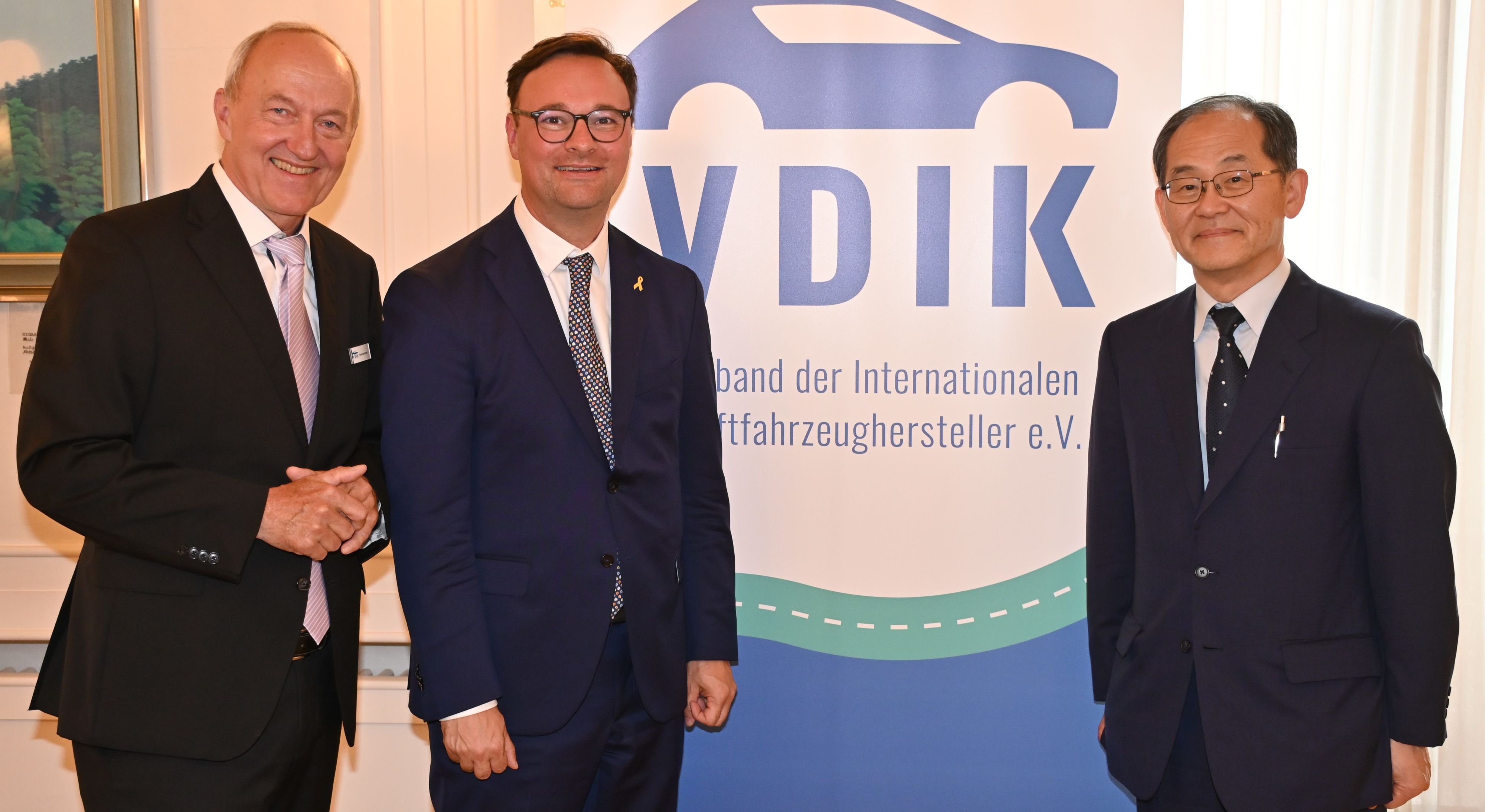
VDIK President Imelda Labbé: “International manufacturers are making it possible for broad segments of the population to transition to electric mobility through affordable vehicles, as evidenced by the rising share of new registrations. Vehicles of all brands remain eligible for subsidies under the federal government’s planned program, despite the Industrial Accelerator Act (IAA). This is a positive sign, but it is now crucial that the application process for the subsidies is implemented quickly and without red tape.”
New registrations of plug-in hybrid vehicles (PHEVs) also posted double-digit growth rates again in February. A total of 24,328 new PHEVs hit the roads, representing a 24.5 percent increase over the same month last year. Their share of all new passenger car registrations rose to 11.5 percent, about 1.9 percentage points higher than in February 2025. The market share of international automakers in the plug-in hybrid segment stood at 34.4 percent in February. After two months, the PHEV market has a total market share of 11.4 percent in the current year.
Together, electric vehicles (BEVs, plug-in hybrids, and fuel cell vehicles) accounted for a market share of 33.4 percent in February, with 70,606 new registrations. This represents a 27.3 percent increase compared to the same month last year. Since the start of the year, the electric vehicle market has grown by 25.4 percent.
New registrations of non-plug-in hybrid vehicles rose only moderately in February, by 4.1 percent. 60,510 new registrations represent a 28.6 percent share of new passenger car registrations. The market share of international automakers in the hybrid segment stood at 44.1 percent in February 2026. Since the beginning of the year, approximately 1.1 percent more non-plug-in hybrid vehicles have been newly registered than in the same period last year.
In addition, 397 new LPG-powered passenger cars (-48.2 percent) were registered in February. Since the beginning of the year, new registrations of LPG-powered passenger cars have totaled 677 units (-58.4 percent).
New registrations of pure combustion engine passenger cars reached 79,742 units in February, of which 48,404 were gasoline-powered (-14.9 percent) and 31,338 were diesel-powered (-2.4 percent). Gasoline-powered cars accounted for 22.9 percent of passenger car registrations, while diesel-powered cars accounted for 14.8 percent.
| February | January-February | |||||||
|---|---|---|---|---|---|---|---|---|
| +/- (%) | Share of total car market (%) | Share of international brands (%) | +/- (%) | ‘hare of total car market (%) | Share of international brands (%) | |||
| BEV | 46.275 | 28,7 | 21,9 | 45,3 | 88.967 | 26,3 | 22,0 | 45,1 |
| PHEV | 24.328 | 24,5 | 11,5 | 34,4 | 46.118 | 23,8 | 11,4 | 34,5 |
| FCEV | 3 | -0,0 | 0,0 | 100,0 | 5 | 0,0 | 0,0 | 100,0 |
| Electric Vehicles (total) | 70.606 | 27,3 | 33,4 | 41,5 | 135.090 | 25,4 | 33,3 | 41,5 |
| HEV including: | 60.510 | 4,1 | 28,6 | 44,1 | 118.716 | 1,1 | 29,3 | 43,4 |
| full-hybrid | 11.103 | 37,4 | 5,3 | 89,2 | 20.157 | 27,9 | 5,0 | 89,3 |
| mild-hybrid | 49.407 | -1,3 | 23,4 | 34,0 | 98.559 | -3,0 | 24,3 | 34,0 |
| CNG | 0 | 0,0 | 0,0 | – | 0 | – | 0,0 | – |
| LPG | 397 | -48,2 | 0,2 | 99,0 | 677 | -58,4 | 0,2 | 98,4 |
| Alternative Drivetrains (total) | 131.513 | 15,0 | 62,3 | 42,9 | 254.483 | 12,2 | 62,8 | 42,5 |
| Petrol | 48.404 | -14,9 | 22,9 | 47,0 | 92.099 | -22,8 | 22,7 | 44,9 |
| Diesel | 31.338 | -2,4 | 14,8 | 58.647 | -9,9 | 14,5 | ||
| Passenger car (total) | 211.262 | 3,8 | 44,4 | 405.243 | -1,4 | 43,4 | ||
Electric vehicles: BEV, PHEV und FCEV
BEV, Batterieelektrisches Fahrzeug, engl: Battery Electric Vehicle
PHEV, Plug-In-Hybrid, engl: Plug-In Hybrid Electric Vehicle
FCEV, Brennstoffzellenfahrzeug / Wasserstofffahrzeug, engl.: Fuel Cell Electric Vehicle
Hybride, Hybrid ohne Stecker bzw. nicht aufladbar, engl.: Hybrid Electric Vehicle
CNG, Gasförmiges Erdgas, engl: Compressed Natural Gas
LPG, Flüssiggas bzw. Autogas, engl: Liquified Petroleum Gas
Models with a maximum e-motor output of 20 KW are classified as mild hybrids, while full hybrids have a maximum e-motor output of more than 20 KW.