

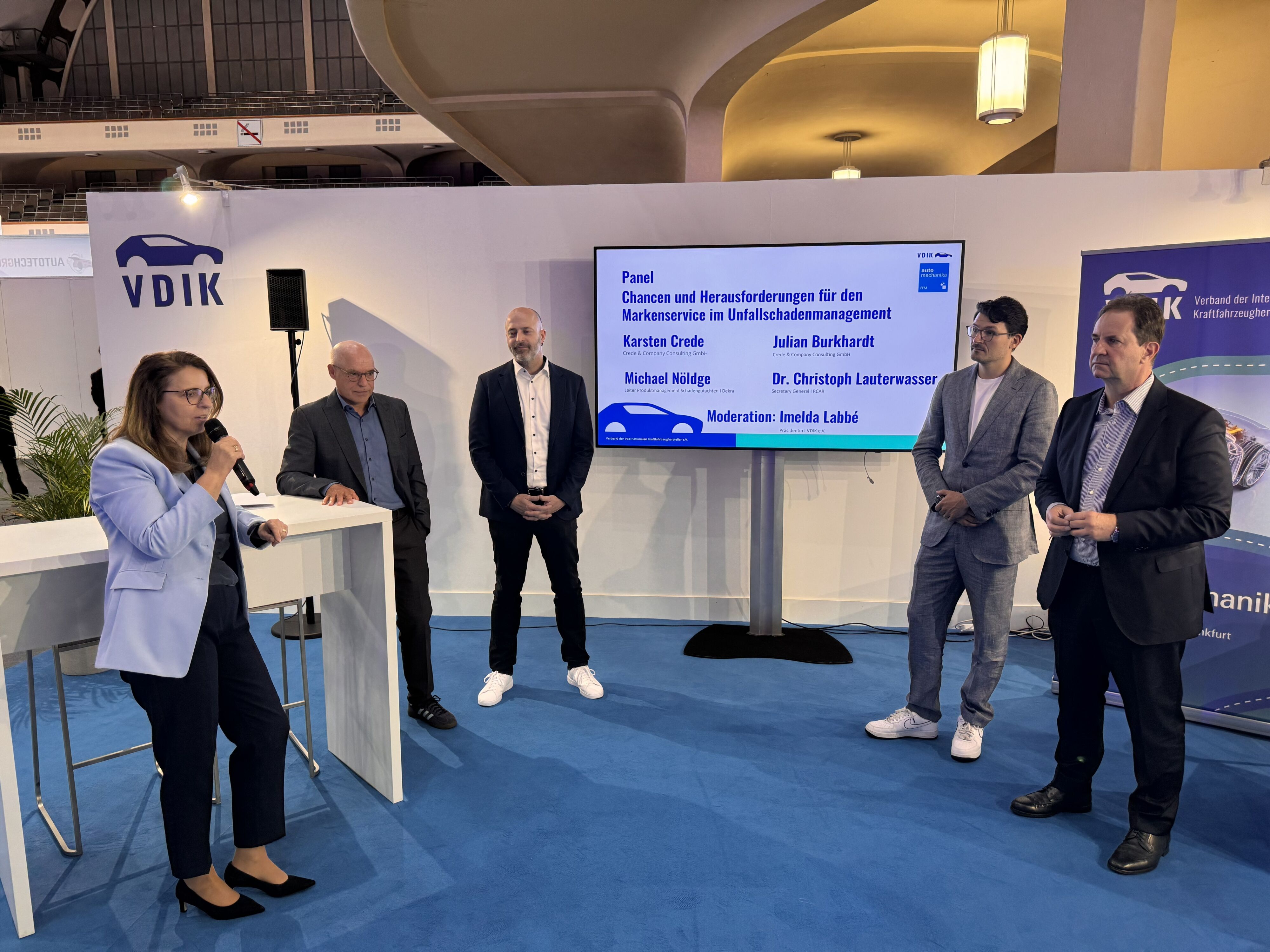
Claims management offers considerable potential for greater efficiency, faster processes and lower repair costs. At the same time, the bodywork and paintwork sector represents a key area of business within the after-sales division of VDIK member companies, and its future must be safeguarded. This became clear during the expert panel discussion ‘Potential in Claims Management’ organised by the Association of International Motor Vehicle Manufacturers (VDIK) as part of Automechanika Frankfurt. Closer cooperation throughout the entire repair chain and the consistent integration of vehicle, repair and claims data are crucial.
“We can tap into considerable potential in claims management – both in terms of processes and efficiency. To achieve this, we must make more consistent use of the technical possibilities available and improve collaboration throughout the entire repair chain,” said VDIK President Imelda Labbé.
Common goals for the entire repair chain
Karsten Crede of Crede Consulting pointed out that, alongside the actual repair costs, process costs and administration represent a significant cost factor. Rising overall repair costs are increasing the pressure on insurance premiums. At the same time, the interests of the industry, the retail sector and insurers do not always align. “The pursuit of self-optimisation by individual players can undermine the efficiency of the system as a whole,” said Crede. Common objectives, key performance indicators and a shared, interconnected database are therefore essential. Potential opportunities include ‘repair-first’ concepts, an intelligent mix of parts, efficient workshop networks and long-term parts agreements. A shared data and claims platform could support decision-making and enable savings throughout the entire repair chain.
Making better use of vehicle data for claims handling
Julian Burkhardt from Volkswagen Group Info Services (GIS) explained the opportunities offered by connected car data. The sensors in modern vehicles also record relevant information at the moment of an accident. “The technical framework is already a reality. However, the gap between what is technically possible and its practical application is constantly widening,” said Burkhardt. In future, connected data platforms could help to assess damage more quickly and partially automate processes.
Michael Nöldge from DEKRA emphasised the importance of the claims process for customer loyalty in the after-sales sector. “The customer assesses the overall outcome, not individual steps in the process,” said Nöldge. A coordinated network comprising the car dealership, the loss adjuster, the solicitor, the insurer and the customer is therefore crucial. The experience following an accident can play a decisive role in determining whether a customer remains loyal to the brand.
Making the most of repair options for complex vehicle technology
Dr Christoph Lauterwasser of the Research Council for Automobile Repairs (RCAR) highlighted the increasing complexity of modern vehicles. Whilst modern driver assistance systems can prevent damage – parking emergency braking systems, for example, can prevent up to 66 per cent of parking collisions – if an accident does occur, sensors and other components may be affected in addition to visible damage. This makes it all the more important to determine which components can be repaired and which actually need to be replaced.
The expert discussion made it clear that the technical prerequisites for more efficient claims management are largely in place. The task now is to better integrate data, processes and stakeholders, and to demonstrate the benefits of networked claims handling using concrete practical examples.
“We have the technology, the data and the expertise. Now we must work together to put this potential into practice. If we view the repair chain as a single integrated system, insurers, garages and manufacturers will all benefit – but above all, so will customers,” said Labbé.