

Brand-specific after-sales services are facing a fundamental transformation. Delayed servicing and repairs, rising costs, and new demands arising from electromobility, digitalisation and artificial intelligence are putting pressure on the business. At the same time, after-sales services are becoming increasingly important for customer loyalty and profitability. This became clear at the Aftersales Forum organised by the Association of International Motor Vehicle Manufacturers (VDIK) at Automechanika Frankfurt.
Prof. Stefan Reindl from the Institute for Automotive Economics (IfA) kicked off the event by presenting the latest service study. Despite a large and increasingly ageing passenger car fleet, the service sector is on the brink of far-reaching structural change. The market potential stands at around 77.9 billion euros, though only 69 per cent of this has been realised to date. Rising costs, delayed repairs and a shortage of skilled workers are holding back the business. At the same time, high-voltage and battery technology, driver assistance systems, digitalisation, AI and cybersecurity are gaining in importance. Although the service market is expected to grow significantly by 2035, the real volume of services and the number of traditional working hours are likely to fall. Growth will therefore stem primarily from higher prices, greater productivity and more technologically sophisticated services.
“Brand loyalty is determined by service”
Arnd Franz, CEO of MAHLE, spoke about opportunities for collaboration and future strategies. One opportunity, he said, lies in intelligently combining single-brand and multi-brand services and broadening organisational structures. Artificial intelligence is also set to become a key driver – for example, in diagnostics, customer communication and parts search. Mobile repair and service offerings could also help to provide cost-effective support for the growing number of older vehicles. “Brand loyalty is determined by service,” emphasised Franz. In addition to technical expertise, accessibility and customer relations are particularly crucial in this regard.
Anna Gabriel of Porsche Consulting also sees after-sales as crucial to the industry’s future viability. The dynamics of profitability are changing: turnover may rise, whilst margins fall. “The loss creeps up quietly,” said Gabriel. Rising service and parts prices are being met by customers who are increasingly unwilling or unable to bear these costs. Competition is therefore less about the one-off sale of a vehicle and more about long-term access to the customer. “Tomorrow’s winners will drive value rather than turnover.”
“Combining technology, efficiency and customer focus”
“The future viability of dealership services will depend on how successfully we can combine technological innovation, efficient structures, trust in the brand and personalised customer care – whilst at the same time developing new models of cooperation that go beyond the boundaries of traditional dealership services,” said VDIK President Imelda Labbé, summarising the key challenge.
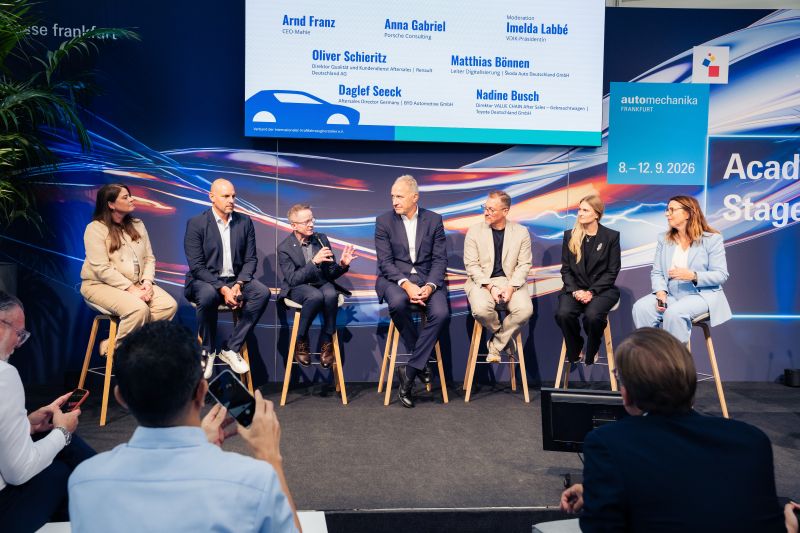
Daglef Seeck (BYD), Nadine Busch (Toyota) and Matthias Bönnen (Škoda) demonstrated how manufacturers are responding to these challenges during the subsequent best-practice panel, moderated by VDIK President Imelda Labbé.
For BYD, the focus is on the rapid scalability of the service organisation. “To be able to sell cars, we need service organisations that work,” explained Seeck. A particular challenge, he said, is the rapid establishment and management of a large dealer network. Artificial intelligence could help to make processes more efficient. Otherwise, when it comes to dealer support, for example, tens of thousands of enquiries would have to be answered individually.
Toyota places a strong emphasis on customer loyalty and long-term relationships. Nadine Busch made it clear: “We don’t want to lose any more customers.” The future of service is already being rolled out and is becoming increasingly digital. At the same time, on-site service staff remain a crucial factor.
With Toyota Relax, the manufacturer aims to retain customers with older vehicles as long-term brand loyalists. The warranty can last for up to 15 years. The service thus becomes a tool for customer loyalty – and, at the same time, a starting point for the next vehicle purchase.
At Škoda, the focus is on the digitalisation of dealer support. Matthias Bönnen emphasised the importance of cooperation between the manufacturer, the dealer and the customer. Standardised processes and reliable data sources are prerequisites for successful digital processes. Support must be provided as early as possible and should not only begin once a problem arises. “Simply adding AI on top doesn’t work,” said Bönnen. Efficient, binding and partner-oriented processes are crucial as the foundation for the use of new technologies.
Service is becoming a strategic link between the brand and the customer
The Aftersales Forum made it clear that, in future, aftersales will extend far beyond traditional maintenance and repair services. Digital touchpoints, AI, warranties, new service concepts and closer networking amongst stakeholders will become key components of the business model. At the same time, personal customer relationships remain crucial.
As a result, aftersales is evolving from a downstream business area into a strategic link between manufacturer, retailer, brand and customer.
Press photo: VDIK Aftersales Forum Automechanika (Source: VDIK)